

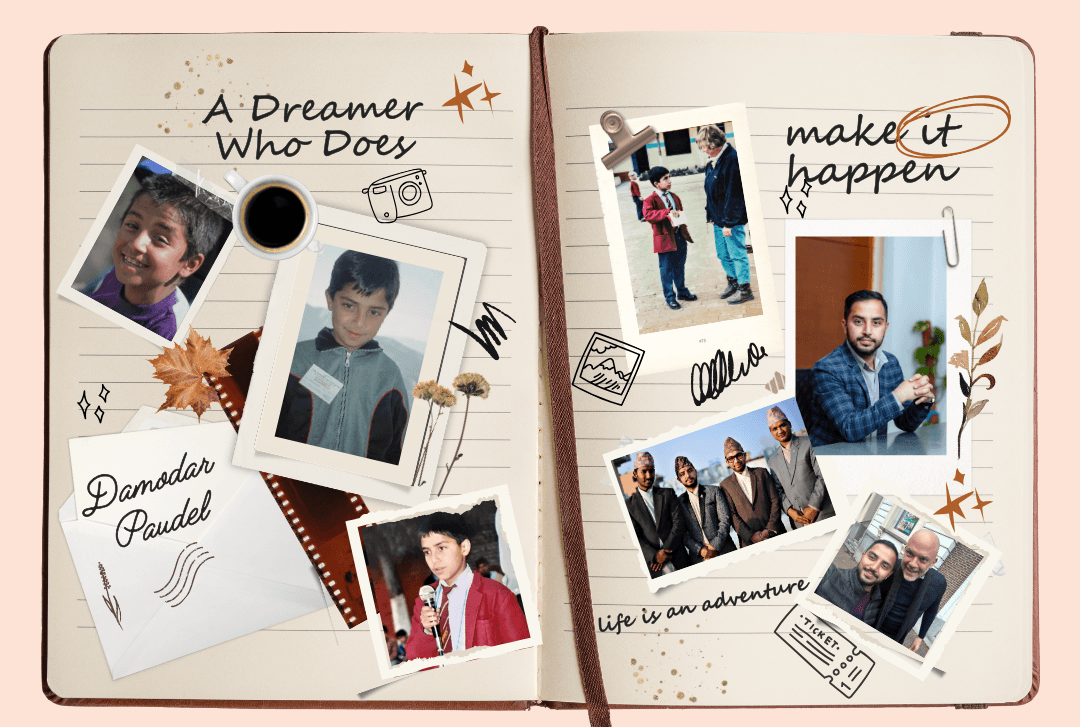
What does it take for a boy from a small Himalayan village to one day stand as an entrepreneur providing jobs to more than a hundred youths? Is it destiny? Is it luck? Or is it the relentless determination to turn a dream into a living reality?
This is the journey of a dreamer who dared to do.
Ramche – My early life
I was born in Ramche, a small village in the Sindupalchowk district of northern Nepal. Life in the Himalayas was not easy then, and in many ways it still isn’t. Yet Ramche played a defining role in shaping who I am. It taught me resilience, dignity, and a strong sense of identity that comes from generations of my family who lived there before me.
My father served as a government teacher and retired early after completing 18 years in the profession. My mother is also an independent woman, who is more into cultivation and agriculture farming in our village. She manages all the household responsibilities and groceries on her own.
When I was five years old, my parents sent me to Kathmandu for my schooling, hoping I would have access to better education and more opportunities. However, after just two years, the financial burden became too much for them to bear. They had no choice but to bring me back to our village. I still remember the heartbreak of leaving behind my school in Kathmandu.
Vajra Foundation - It all truly began with the Vajra Foundation
The Vajra Foundation, a Dutch charity organization founded by Maarten Olthof in 1997, had been supporting development work in Nepal through education, healthcare, and ecological projects. One of their initiatives eventually reached my village, Ramche. Dutch volunteers began arriving to work on kitchen gardening, health, water supply, and education. Their presence brought new ideas, new energy, and a sense of possibility.
One day, a volunteer named Heleen van der Linde, a physiotherapist, came to visit. I still remember walking down to Barabishe, a small town in my district, to receive her. At that time, there were no roads to Ramche. I carried a sack of groceries, about five to seven kilos, and walked all the way uphill with her.
On that walk, something remarkable happened. I knew a little English, and Heleen began asking me about my life, my interests, and my dreams. I helped her translate and guided her through the village. That simple conversation created an unexpected bond. From that day on, I developed a deep appreciation for Dutch people and their culture.
A month later, a letter arrived for me. Inside was a question that would change my life: “Would you like to study at a boarding school?” My answer was, of course, yes. That single opportunity became the turning point of my future.
Alongside my studies, I began volunteering whenever I had the chance. During school holidays, I returned to my village and assisted the Dutch visitors as a translator, guiding them through the community, helping with their projects, and learning from their thoughtful approach to serving others.
At the time, these felt like small and simple acts. But looking back, I now see how much they shaped my values. I was learning the power of giving, the importance of empathy, and the difference one person can make when they choose to help.
Even after completing my academic education, I was still working to achieve my Chartered Accountancy qualification. When I finally felt capable of standing on my own, I asked Heleen to discontinue my scholarship and offer it to another deserving student who needed the support. I wanted someone else to experience the same opportunity that had transformed my life.
Founding a Dream – Four Symmetrons
In my late twenties, I took a bold step. Along with three of my closest friends, who had become like family, I decided to start a company. We shared a common vision: to build more than just a business. We wanted to create opportunities for talented young people so they could stay and grow in Nepal instead of leaving for opportunities abroad.
This was not simply an idea. It was a necessity. Every day, more than 2,000 people leave Nepal in search of better prospects. Nepal’s brain drain index today is 6.10, one of the highest in the world. These statistics are not just numbers to me. They represent the faces of friends, neighbours, and bright young people who felt they had no choice but to leave their home. I wanted to help change that reality.
With that intention, we opened a small workspace with limited resources and started Four Symmetrons Business Consulting Pvt. Ltd. Our beginnings were humble. We had local clients, long working days, and endless uncertainties. But we also had trust, friendship, and an unwavering belief in our shared dream.
Despite being a small startup with tight resources, we believed in giving back from the beginning. We supported the education of two of our own staff members and carried out modest CSR initiatives in our community. These were not grand projects, but they were meaningful. They reflected who we were and what we stood for: a company that grows by uplifting others and proving that business progress and social responsibility can move forward together.
I often asked myself whether a small company like ours could truly make a difference. Could we offer meaningful opportunities in a country where jobs are scarce and young talent is leaving in record numbers?
Over time, I realized the answer was yes. But it required commitment, teamwork, and a clear sense of purpose. Our early success was never just about business. It was about laying the foundation for something far more meaningful: helping people, strengthening communities, and inspiring young graduates to dream boldly while staying rooted in Nepal.
Reunion with Koert
Unexpectedly, after 20 years, I met Koert Huisman again. He had been one of the Dutch volunteers I met as a child in Ramche. By this time, Koert was the CEO of Plieger, a leading sanitary products company in the Netherlands.
In celebration of Plieger’s 100th anniversary, Koert wanted to give back to society. On behalf of his company, he made a donation of one lakh Nepali rupees to the Vajra Foundation. In his email to the foundation, he added a simple request: “I want to reconnect with that boy from Ramche.”
After two decades, we finally met again. When Koert came to Nepal to visit the Vajra projects, I took him back to my village. We spent a night there, and my grandmother welcomed him with tika and blessings. That evening, we shared a simple Nepali meal together. It was deeply emotional for both of us, as we relived memories that had stayed with us for years.
The next day, I brought him to my office. There, he met my business partners, who were also my closest friends. We shared with him the story of our company and the dream we were building together.
Koert was proud to see how far I had come, from a child in an underprivileged village to an entrepreneur leading a company with purpose. For me, our reunion was much more than a nostalgic moment. It was the beginning of something bigger. Together, we began to wonder how his network in the Netherlands could support Nepal and how we could create sustainable opportunities for young people.
I had no way of knowing then that this reconnection would soon become the lifeline that saved my company during one of the darkest times in history, the Covid pandemic.
The Darkest Hour – Covid-19
Then came one of the toughest periods in our journey: the Covid-19 pandemic. Like many other businesses, our company was hit hard. Projects were delayed, clients faced uncertainty, and debts began to accumulate. For the first time, I felt the full weight of responsibility, not just for myself but for my entire team.
I still remember a crucial meeting with my co-founders. One of them said, “We need to inject more capital into the company, or we cannot survive.” I sat there quietly. I had nothing to contribute. For a moment, it felt as though our dream, the dream of creating jobs, supporting young graduates, and giving back to society might fall apart.
And then, as if by fate, I received a call from Koert. He asked about our situation and listened with genuine concern. Out of kindness, he offered to cover our overhead costs, but I politely declined. I wanted us to find a way forward on our own.
Koert did not stop there. Determined to support us, he proposed a new assignment in collaboration with Plieger. It was a lifeline disguised as an opportunity: a project to update and complete product data for their webshop. We accepted the challenge, and the results were a success.
This project not only allowed us to retain our team and clear our debts, it also laid the groundwork for a long-term partnership that would shape the next chapter of our company’s growth.
That first project with Plieger marked the beginning of a new chapter. What started as a lifeline during a crisis soon evolved into a long-term partnership. Our work expanded from product data management to IT projects, content services, invoice entry, and data enrichment. Through Plieger, we were introduced to other global clients such as DEPT® and Data Circle, which opened the door to collaborations with companies like Stanley Black & Decker.
Looking back, I realize that our journey was shaped not just by the opportunities we received, but by how we responded to them. Koert’s support played a critical role, but it was our team, the directors and every employee whose commitment, resilience, and belief in our mission helped transform a small startup into a company that now provides meaningful employment to more than 100 young graduates.
And this is only the beginning. My vision is to grow even further, to create thousands of jobs, support aspiring entrepreneurs, and offer talented Nepalis the chance to build their future here at home rather than leaving the country. The world does not only need dreamers. It needs dreamers who take action.
Damodar Paudel
Managing Director