

How We Eliminated 800+ Duplicate Invoices With a Tool We Built Ourselves


A quiet micro-process automation win
It Was the Same Problem. Every Single Period.
Our team - supporting the bookkeeping function of a European client - would work through the period, processing invoices, keeping the flow moving. And somewhere in the middle of it all, the duplicates would start appearing. Not in ones or twos. In hundreds.
Over two consecutive accounting periods alone, our team manually identified and deleted over 1,400 duplicate invoice entries from the client's ERP system - spread across multiple entities. Each one reviewed, validated, and removed by hand.
The frustrating part wasn't just the volume. It was that the problem kept coming back. Same cause, same cleanup, same cost - period after period.
Where Were All These Duplicates Coming From?
Before doing anything, we mapped the root causes. Three patterns kept showing up.
1. OCR reading every attachment as an invoice: Suppliers often attach multiple files to a single email - the actual invoice PDF, maybe a CSV, maybe a JPG or PNG brand image. The OCR system doesn't distinguish between them. It reads every file as a potential invoice and pushes them all into the ERP - flooding the system with unintended duplicate entries.
2. Suppliers bundling invoices with supporting documents: A common supplier habit: attaching both the invoice PDF and an order confirmation or specification PDF in the same email. Again, OCR processes both as invoices. Only one belongs in the system; the other has to be found and cancelled manually.
3. Duplicates only flagged after submission: This was the most time-consuming part. The system often wouldn't flag the duplicate during data entry. The team fills in all mandatory fields, submits, and only then receives the duplicate flag. That meant going back, finding it, and deleting it. For a high-volume period close, that loop adds up quickly.
The Real Cost of a “Small” Issue
Each duplicate invoice required individual review, validation, and manual deletion or cancellation. The ripple effects were significant:
- During period close - already the most pressured point in the cycle - the team had to pause core work to hunt down and remove duplicates
- Cancellation counts in the system were inflated, sometimes under incorrect supplier names, making reports harder to trust
- Team bandwidth was consumed by rework rather than value-added work
At one point, the client acknowledged the issue and asked directly: "Can you solve this?"
We said yes - At that point, we didn't have a tool for this specific problem. But we decided to build one.
A Lightweight Automation Tool, Built In-House
Rather than waiting for an ERP-level fix or expensive middleware, our team designed a practical, end-to-end automation workflow using accessible tools. The solution is straightforward in concept: intercept the problem before it reaches the ERP.
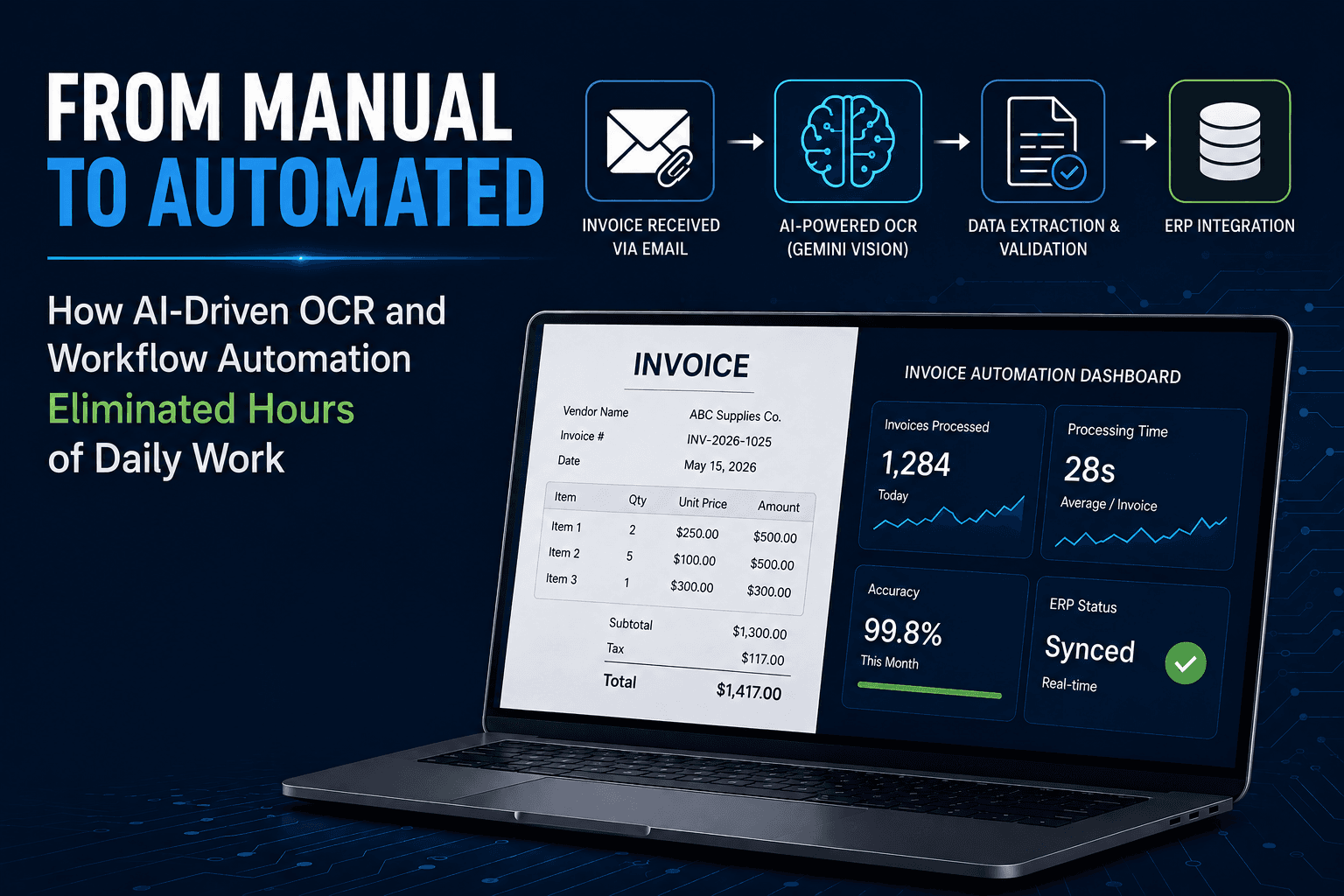
Step 1 – Monitor the Email inbox: Using the Python and the Gmail API with OAuth 2.0, the application scans a designated Gmail inbox for invoice-related emails based on custom filters (sender, subject keywords, etc.). Our remote colleagues simply forward relevant emails - individually or in batch - to this inbox.
Step 2 - PDF Extraction: The tool automatically identifies and extracts only the PDF invoice attachments from filtered emails. Critically, it also handles .eml format - meaning invoices forwarded as email attachments within emails are correctly unpacked and processed. Non-invoice files (images, CSVs) are excluded.
Step 3 - Upload to the ERP automatically: Using Selenium WebDriver, each extracted PDF is uploaded directly into the client's ERP through the browser interface. It runs as a simple Windows batch file in the background - the team can keep working on other tasks while it runs. Built-in confirmation and logging prevents re-uploading already processed files.
No new software licenses. No changes to the client's ERP configuration. No dependency on the client's IT team. Just a targeted fix for a specific, costly problem.
A Small Build with a Real Difference
The result was simple - but meaningful. Across all entities, our team was handling roughly 800 duplicate invoice entries every four-week period. Each one required around two minutes to review, validate, and remove.
That's approximately 1,600 minutes - or over 26 hours - of manual work per period, now largely eliminated.
Beyond the numbers, period closes run more smoothly, cancellation volumes have dropped, and the team has more room to focus on core bookkeeping - which is where our expertise belongs.
Closing Statement
Finance teams carry a lot of these invisible burdens - processes that technically work, just not well enough. They rarely make it onto a priority list because they're not broken enough to escalate, yet too persistent to ignore. So, they stay. The workaround quietly becomes the workflow.
Most of these problems don't need a transformation. They need a question, a bit of time, and a team willing to sit with the problem long enough to actually solve it. That's the Four Symmetrons way. We don't just process transactions. We think about the systems around those transactions and ask: how do we make this better?
Have a project in mind? Let's get to worker
Feel free to reach out if you want to collaborate with us info@foursymmetrons.com or simply have a chat.